
ADA kitchen sink requirements set the maximum rim height, the open space underneath for knees and toes, the floor area in front, and the faucet controls a sink needs so people with disabilities can use it from a seated position. The Americans with Disabilities Act of 1990, the federal civil rights law protecting individuals with disabilities, is enforced through the 2010 ADA Standards for Accessible Design, and chapter 6 of those standards covers lavatories and sinks. Knowing the numbers before cabinets are ordered prevents failed inspections and costly rework.
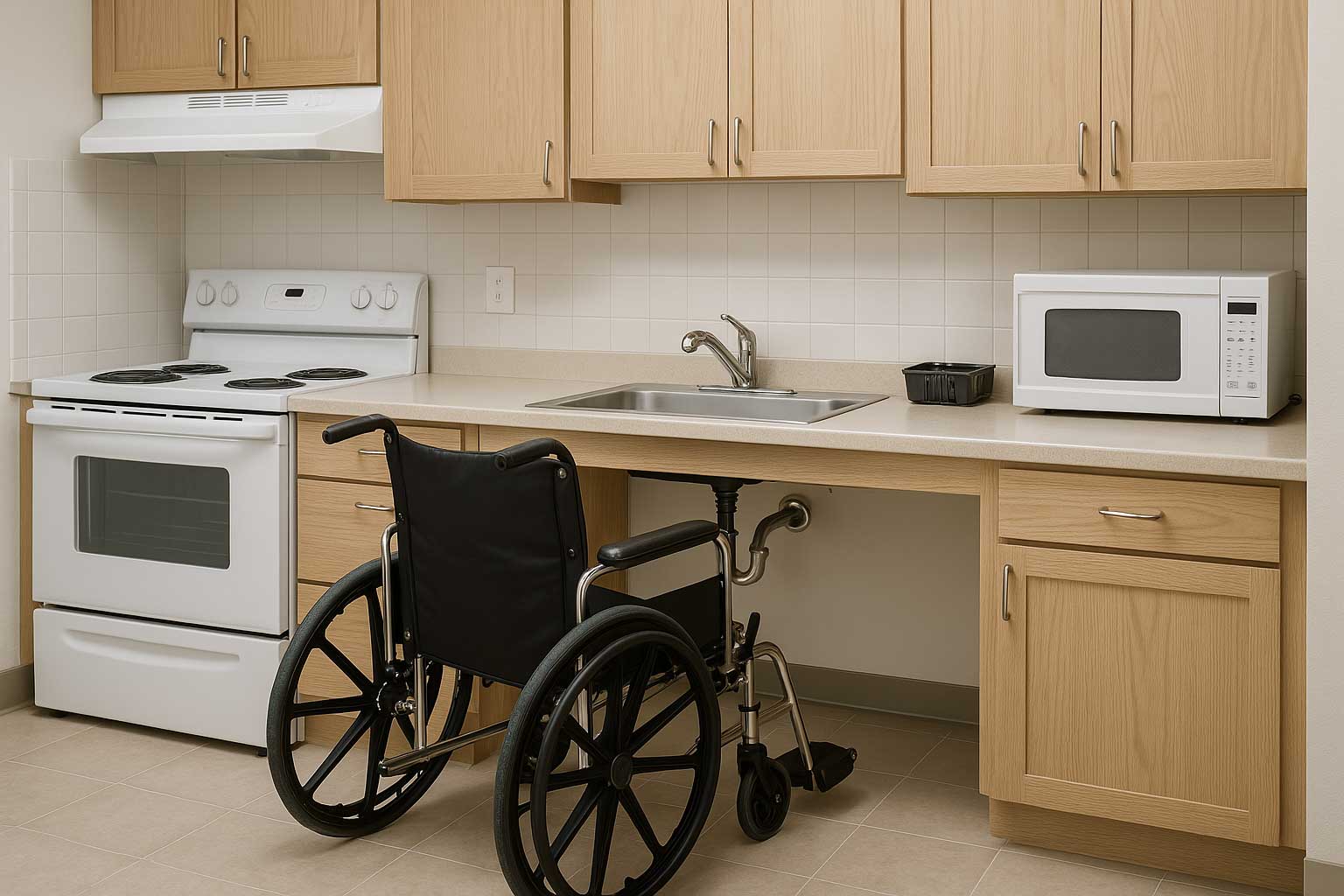
ADA Kitchen Sink Requirements at a Glance
Every dimension below comes from the 2010 ADA Standards, measured from the finished floor and the front edge of the counter.
| Element | Requirement | Section |
|---|---|---|
| Rim or counter height | 34″ maximum, to whichever is higher | 606.3 |
| Knee clearance | 27″ high and 30″ wide minimum | 306.3 |
| Knee depth | 8″ minimum at 27″ high, 11″ minimum at 9″ high | 306.3 |
| Toe clearance | Floor to 9″ high, 17″ to 25″ deep overall | 306.2 |
| Clear floor space | 30″ by 48″, forward approach | 305, 606.2 |
| Faucet | One hand, no tight grasping, 5 lb force maximum | 606.4, 309 |
| Exposed pipes | Insulated or configured to prevent contact | 606.5 |
Who Has to Meet These Rules
The 2010 Standards apply to public accommodations, commercial facilities, government buildings, and accessible units in covered housing: restaurants, office breakrooms, hotel kitchenettes. A private single-family home is not legally required to comply, but homeowners planning to age in place use the same dimensions as their benchmark.
Residential dwelling units get two exceptions. A sink that adjusts between 29 and 36 inches high is allowed when the rough-in plumbing supports the lower position. Cabinetry underneath is permitted if it comes out without removing the fixture, the finished floor extends below it, and the wall behind is finished.
Sink Height and the 34-Inch Rim Limit
The rim or counter surface, whichever is higher, cannot sit higher than 34 inches above the finished floor. Most contractors aim for 32 to 33 inches because that height works for a seated wheelchair user and still feels natural standing.
Faucet controls and the drain stopper should fall within 25 inches of the front edge, the deepest forward reach the standards allow over an obstruction. Watch the work surface on either side, too: a continuous countertop that climbs past the accessible section can block the approach and fail inspection.
Mounting style changes the math. An undermount sink keeps the counter as the high point, so height stays predictable. A drop-in rim adds about an inch, which can push a 33-inch counter past the maximum height.
Knee and Toe Clearance Under the Sink
Knee clearance is the open space where a seated user’s legs fit. It must be at least 27 inches high and 30 inches wide. The depth can taper: at least 8 inches deep at the top and at least 11 inches at 9 inches above the floor, so the underside can slope back as it drops.
Toe clearance is the strip between the floor and 9 inches up. Together, the knee and toe space must reach at least 17 inches deep, and only the first 25 inches under the fixture count.
Pipes, garbage disposals, and supply lines cannot protrude into this zone. Supply and drain lines must be insulated or configured to prevent contact, because hot pipes burn legs with limited sensation, and the standards also bar sharp or abrasive surfaces under the bowl. Removing the base cabinet under the sink entirely is the simplest path; a removable panel works if the space meets clearance requirements once it is out.
Clear Floor Space and Approach
A 30 by 48 inch clear floor space must sit in front of the sink for a forward approach, so the user rolls into the knee space and faces the sink bowl. The floor should be level, firm, and free of loose mats, the same surface logic used at a wheelchair accessible entrance.
A parallel (side) approach is permitted only where the room has no cooktop or conventional range, such as a breakroom. In a U-shaped kitchen enclosed on three sides, opposing cabinets, appliances, or walls need 60 inches between them so a wheelchair can turn; a pass-through galley needs 40 inches.
Faucet Rules: One Hand, Five Pounds
The faucet must operate with one hand, without tight grasping, pinching, or twisting of the wrist, and with no more than 5 pounds of force. Lever handles, push buttons, and touchless sensors all pass. Round knobs and decorative cross handles fail.
Metering faucets must stay open at least 10 seconds. For residential remodels, a single-lever faucet is the most cost-effective ADA compliant option. A thermostatic mixing valve isn’t an ADA mandate, but it fits the intent of the ADA guidelines from the U.S. Access Board by preventing scalds for users who cannot pull away quickly.
Bowl Depth, Drain, and Material
The 2010 Standards set no bowl depth. The 1991 ADA guidelines capped accessible sinks at 6.5 inches, and most ADA compliant kitchen sinks are still built 5 to 6.5 inches deep. The geometry explains why: the rim limit minus 27 inches of knee space leaves about 7 inches for the bowl, drain, and counter thickness.
Choose a sink with a rear drain. It pushes the trap toward the wall and frees knee space that a center drain eats.
Stainless steel is the default for accessible kitchen sinks: light, durable, and easy to form in shallow profiles. Composite and fireclay sinks weigh more, which matters with no cabinet base below. If the counter cannot be lowered, a wall-mounted sink bolted to blocking gives full control over mounting height.
Retrofitting an Existing Kitchen Sink
A full tear-out is not always necessary. These changes address the most common failures:
- Swap round or cross handles for a lever or touchless faucet.
- Remove the base cabinet doors and shelf to open the space underneath.
- Wrap exposed hot and drain pipes. Foam covers cost under ten dollars.
- Replace a full-size disposal that hangs into the knee zone with a compact unit, or move it to an adjacent station.
- Cut and re-support the counter section around the kitchen sink to the rim limit or lower without replacing the full run.
- Keep trash cans and carts out of the 30 by 48 inch area in front.
Start by measuring rim height, the open space under the sink, and the floor area in front, then check all three against the ADA kitchen sink requirements in the table above. If the counter has to drop or the cabinet has to go, plan it as part of a handicap kitchen remodeling project so the plumbing moves once. Related guides cover handicap bathroom modifications, accessible bathroom remodeling, and wheelchair ramp installation, or use the contact form to ask about your layout.
ADA Kitchen Sink FAQ
Do ADA kitchen sink requirements apply to private homes?
Not legally. The ADA covers public accommodations, commercial facilities, government buildings, and covered housing units, not privately owned single-family homes. Homeowners still borrow the dimensions because they are the most widely used accessibility benchmark.
How deep should an ADA kitchen sink be?
Between 5 and 6.5 inches is the practical range. The 2010 Standards set no depth, but a shallow bowl is usually the only way to fit the required knee space under the maximum rim height.
Are touchless faucets required for ADA compliance?
No. Any faucet that works with one hand, without tight grasping or wrist twisting, at 5 pounds of force or less, qualifies. Levers, push buttons, and sensor models all pass.
What is the difference between universal design and ADA compliance?
Universal design is a philosophy that makes spaces usable by everyone regardless of age or disability, without specialized adaptation. ADA compliance means meeting the specific measurable standards in the Americans with Disabilities Act and related building codes. A space can follow universal design principles without being fully ADA compliant, and vice versa.