
Handicap bathroom modifications are changes to fixtures, clearances, and surfaces that let someone with limited mobility use the bathroom safely and with less help. They range from a $30 clamp-on seat to a full shower conversion. This guide groups nine of them by effort, so you can fix the riskiest task first and plan bigger work around it.
The CDC reports that about one in four Americans over 65 falls each year, and the risky moments in this room are predictable: stepping over a tub wall, lowering onto a toilet, and turning in a tight space.
Match Each Modification to the Task That Is Hard
Start with what the person struggles to do, not with a product catalog, because people with disabilities rarely need every upgrade. Someone who walks with a walker needs different changes than a full-time wheelchair user who transfers from the side.
| Hard task | Modification | Tier |
|---|---|---|
| Sitting down or standing up at the toilet | Raised seat, comfort-height toilet, grab bar | 1 or 2 |
| Stepping into the bathtub | Transfer bench now, curbless shower later | 1, then 3 |
| Standing through a shower | Shower seat and handheld spray | 1 |
| Turning faucets or knobs | Lever handles | 1 |
| Getting through the door | Wider doorway or pocket door | 2 |
| Reaching the sink while seated | Wall-mounted or open-front sink | 2 |
| Turning a wheelchair around | New layout with a 60 inch turning circle | 3 |
The measurements below come from the 2010 ADA Standards for Accessible Design. The ADA does not cover private single-family homes, so at home these numbers are a proven benchmark, not a legal requirement.
Low-Cost Handicap Bathroom Modifications With No Demolition
Tier 1 changes take a day or less and leave walls and plumbing alone. They’re the right first step toward an accessible bathroom after a new diagnosis, during recovery from surgery, or in a rental.
1. Grab Bars Anchored for Real Loads
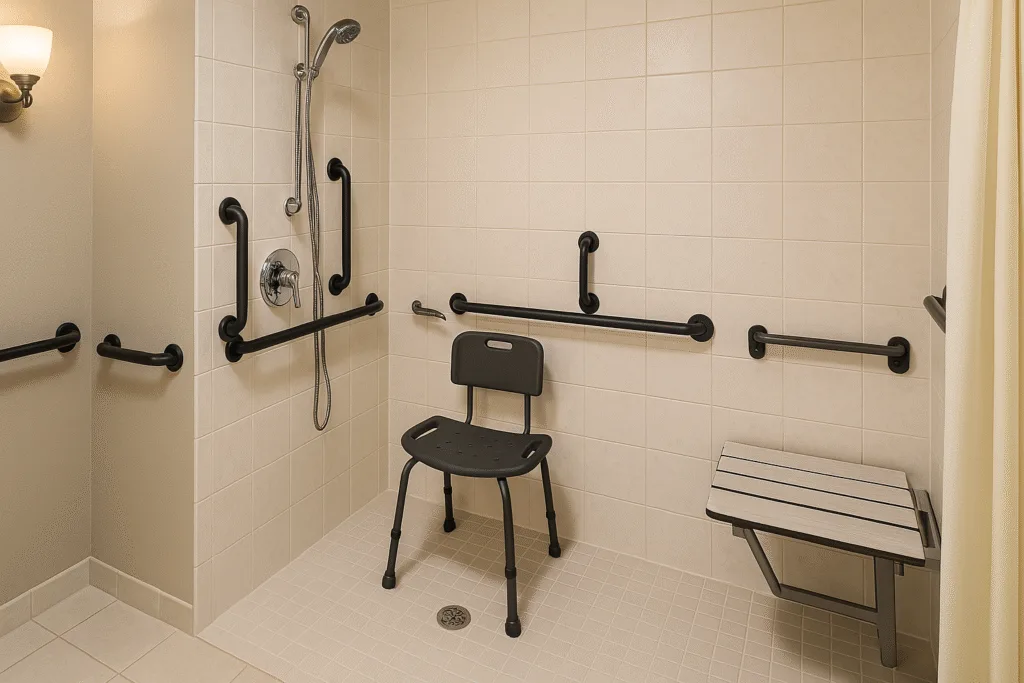
A grab bar is a fixed rail built to hold body weight during a transfer, unlike a towel bar, which pulls out of drywall under load. The standards set the height at 33 to 36 inches (609.4) and require the bar and its mounting to resist 250 pounds of force (609.8). Put them beside the toilet, inside the shower area, and at the entry where the floor changes surface. Installed, expect $100 to $300 per bar.
Without blocking, the installer anchors into studs or uses hardware rated for the load. Avoid suction-cup models entirely. They fail without warning. If a wall gets opened for any other job, we tell homeowners to add plywood blocking around the toilet and tub at the same time, even if only one bar goes up today.
2. Raised Toilet Seat
This clamps onto the existing bowl and adds 3 to 5 inches of height for $30 to $120, with no installation needed. Some models include armrests for extra support. Because it lifts off, it suits shared households where others prefer the standard height.
3. Shower Seat and Handheld Shower
A fold-down or freestanding bench at 17 to 19 inches (610.3) lets someone bathe from a seated position, and a handheld head on a slide bar brings the spray to them. Over a bathtub, a transfer bench straddles the wall, so the person slides across instead of stepping over.
4. Lever Handles on Faucets and Doors
Section 309.4 calls for controls usable with one hand, without tight grasping, pinching, or twisting of the wrist, which rules out most round knobs. A single-lever faucet also sets temperature and flow in one motion.
Tier 2: Swap One Fixture or Widen One Opening
These jobs change a single fixture or doorway, usually a day or two for a plumber or carpenter.
5. Comfort-Height Toilet
A standard toilet sits about 15 inches off the floor. Comfort-height models land in the 17 to 19 inch seat range used for accessible toilets (604.4), roughly chair height. The difference sounds small. It’s not, for anyone with weak knees or hips. Replacement runs $250 to $600 including labor. If the flange is moving anyway, set the centerline 16 to 18 inches from the side wall (604.2) so a grab bar there stays within reach.
6. Roll-Under Sink
Wheelchair users need knee clearance, which means removing the base cabinet. A wall-mounted basin or open-front vanity with at least 27 inches of clearance underneath (306.3) and a rim no higher than 34 inches (606.3) works seated. Insulate exposed pipes so they can’t burn bare legs (606.5), and keep the bottom of the mirror at 40 inches or lower (603.3). The same seated-reach logic shows up in the accessible kitchen sink requirements.
7. Wider Doorway or Pocket Door
A door that’s too narrow blocks wheelchair access entirely. The minimum clear width is 32 inches (404.2.3), measured from the door face to the stop with the door open 90 degrees, and many contractors frame for 36 inches to leave room for power chairs and a caregiver. A pocket door or barn-style slider removes the swing that eats floor space. If you’re planning a wheelchair accessible entrance for other parts of the house, coordinate the hardware so everything matches.
Tier 3: Structural Changes That Rebuild the Room
Tier 3 moves plumbing, floors, or walls. It usually happens when a wheelchair is full time or the current layout can’t fit one, and the whole-room planning on our handicap bathroom remodeling page applies.
8. Curbless Shower Conversion
A curbless shower removes the single biggest trip hazard in the room. Pulling out a standard bathtub usually frees enough floor for a roll-in stall, sized at 30 by 60 inches minimum (608.2.2) with a threshold no higher than 1/2 inch (608.7). A walk-in version with a low threshold suits people who use a walker or have balance issues. Conversions run $3,000 to $8,000 depending on tile and fixtures. Drainage, waterproofing, and stall sizing are covered in our handicap shower remodel guide.
9. A Layout With Real Turning Space and Slip-Resistant Floors
A wheelchair needs a clear 60 inch circle to turn around (304.3.1). The figure people misread is that 60 inches: it’s the diameter of the circle, not a radius, and a vanity or a door swinging into it cancels it out. Around the toilet, the clearance is 60 inches wide by 56 inches deep (604.3.1). For the floor, choose tile rated for wet interior use (a DCOF of 0.42 or higher under ANSI A326.3). A full accessible renovation that relocates fixtures runs $8,000 to $25,000.
Which Modifications to Do First
Order the work by risk, then by how much a later stage would undo it. If someone already struggles with transfers, grab bars and a raised seat go in this week. If a wheelchair is likely within a few years, skip the new vanity and plan the doorway, layout, and shower together so the walls open once.
The same plan serves aging adults who want to age in place, disabled individuals, caregivers, and future buyers, and fixtures built on universal design principles no longer mean you sacrifice style. If you’re considering a handicap accessible pool or ramp installation, plan those alongside your indoor modifications for efficiency. For funding, check with a local organization like United Disabilities Services.
Start by writing down the two tasks that are hardest today and pick the lowest-tier fix for each. Then have a contractor experienced in accessibility work check door width, wall blocking, and floor space before any tile is ordered. If full-time wheelchair use is part of the picture, plan the Tier 3 handicap bathroom modifications first, because they decide where every smaller fixture goes.
Frequently Asked Questions
Will Medicare pay for handicap bathroom modifications?
Original Medicare generally does not pay for grab bars or remodeling. Some Medicare Advantage plans include limited safety benefits. Medicaid waiver programs, the VA’s HISA grant, and Specially Adapted Housing grants for eligible veterans are the more common funding routes.
What are the federal requirements for a handicapped bathroom?
The 2010 ADA Standards for public facilities call for a 60 inch diameter turning space, a 32 inch clear door opening, grab bars 33 to 36 inches high that resist 250 pounds, and a toilet seat 17 to 19 inches high. Private single-family homes are not covered, but these figures are the best benchmark for real accessibility.
Can you redo a bathroom for $5,000?
A targeted project can fit that budget. A walk-in shower conversion runs $3,000 to $8,000, and the Tier 1 and Tier 2 upgrades above cost far less. A full accessible bathroom renovation that relocates fixtures typically runs $8,000 to $25,000.