
The maximum slope of a handicap ramp is 1:12 under the 2010 ADA Standards for Accessible Design: one inch of rise for every 12 inches of horizontal run, about 8.33 percent. The limit sits in section 405.2 and applies to the running grade of every ramp run. The Americans with Disabilities Act of 1990, the federal civil rights law behind those standards, covers public accommodations, commercial facilities and government buildings. Steeper than 1:12, a manual wheelchair rolls back on the climb and gains speed on the descent.
What Is the Maximum Slope of a Handicap Ramp in Percent and Degrees?
A 1:12 ratio equals an 8.33 percent grade, or roughly 4.76 degrees. All three describe the same incline, and confusing them is a common reason homemade ramps end up too steep. A digital level set to degrees reads 4.8 at the legal limit, not 8.
The ADA only treats a surface as a ramp once its grade is steeper than 1:20 (5 percent). Anything at 1:20 or flatter is an ordinary walking surface under section 402.2, with no handrails or intermediate landings required. If the site has room for a 1:20 approach, most wheelchair ramp rules simply fall away.
Rise-to-Length Math With Worked Examples
Measure the total rise in inches and multiply by 12 to get the minimum horizontal length in inches. Since each inch of rise needs one foot of length, the shortcut is easy: rise in inches equals length in feet. Each ramp run may climb no more than 30 inches before a level landing (405.6), and every intermediate landing adds at least 60 inches to the footprint.
| Total rise | Minimum length at 1:12 | Sloped sections | Intermediate landings |
|---|---|---|---|
| 6 in | 6 ft | 1 | 0 |
| 12 in | 12 ft | 1 | 0 |
| 24 in | 24 ft | 1 | 0 |
| 30 in | 30 ft | 1 | 0 |
| 36 in | 36 ft | 2 | 1 |
| 48 in | 48 ft | 2 | 1 |
Example: A 40-Inch Porch Rise
A porch 40 inches above grade needs 40 feet of incline. Because 40 exceeds the 30-inch limit, it becomes two 20-inch climbs of 20 feet each, joined by a 60-inch landing. Add landings at both ends and a straight layout reaches about 55 feet. A switchback with a 60 by 60 inch turning landing (405.7.4) usually fits a front yard far better.
Running Slope vs Cross Slope
Running slope is the grade in the direction of travel. Cross slope is the side-to-side tilt, perpendicular to travel, and it is capped at 1:48, about 2 percent (405.3). Landings get the same 1:48 allowance in every direction.
A sideways tilt pulls a wheelchair toward the low edge, so the user pushes harder with one hand for the whole climb. The usual culprits are decking pitched to shed rain sideways and concrete poured to follow the yard. Check it at several points along the length, not just the ends.
Existing-Site Exceptions: When 1:10 and 1:8 Are Allowed
In existing buildings and facilities, Table 405.2 permits steeper grades only where space limitations rule out 1:12, and only for small rises. Interior projects such as handicap bathroom modifications or ADA kitchen upgrades sometimes use it for a short threshold transition.
| Grade | Maximum rise | Example |
|---|---|---|
| Steeper than 1:12, up to 1:10 | 6 in | 6 in over 60 in |
| Steeper than 1:10, up to 1:8 | 3 in | 3 in over 24 in |
| Steeper than 1:8 | Not permitted | None |
The exception never applies to new construction, and stacking short steep sections to climb a taller change in level does not qualify. Above 6 inches, 1:12 governs.
How to Measure Ramp Slope With a Level
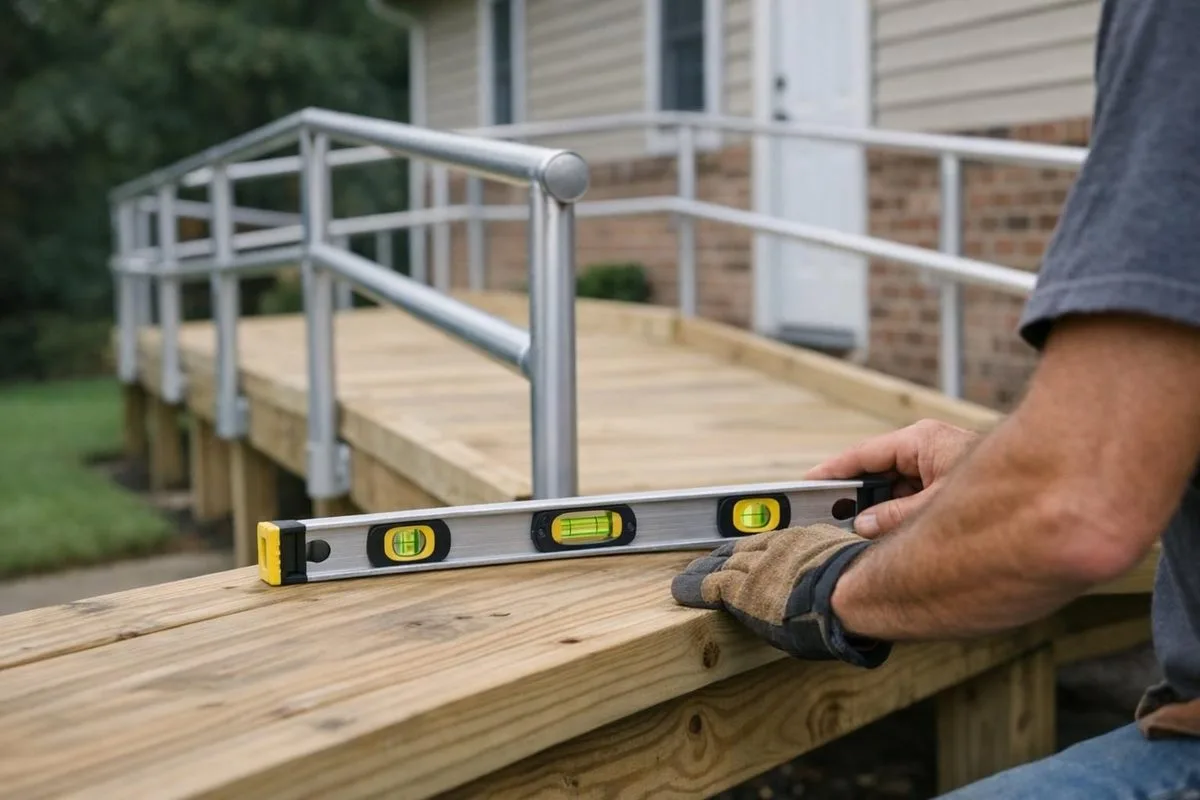
A 24-inch spirit level and a tape measure are enough. At 1:12, the gap under the raised end of a 24-inch level is exactly 2 inches.
- Lay the level on the surface, pointing straight up the incline.
- Lift the downhill end until the bubble centers.
- Measure the gap and divide 24 by it: a 2-inch gap means 1:12.
- Repeat every few feet, because an average of 1:12 can hide a steep hump.
- Turn the level across the width; a gap over 1/2 inch means the tilt exceeds 1:48.
| Ratio | Percent | Degrees | Gap under a 24-in level |
|---|---|---|---|
| 1:48 | 2.08% | 1.19 | 1/2 in |
| 1:20 | 5% | 2.86 | 1.2 in |
| 1:16 | 6.25% | 3.58 | 1.5 in |
| 1:12 | 8.33% | 4.76 | 2 in |
| 1:10 | 10% | 5.71 | 2.4 in |
| 1:8 | 12.5% | 7.13 | 3 in |
Residential Ramps vs ADA Requirements
The ADA does not cover private single-family homes. A ramp at a house falls under the local residential code, usually based on the International Residential Code (IRC). The IRC sets 1:12 for a ramp serving the required exit door, allows 1:8 in limited cases depending on the edition, calls for 36 by 36 inch landings, and requires a handrail on at least one side of any ramp steeper than 1:12. Confirm the adopted edition with the local building department.
Legal is not the same as comfortable. For a wheelchair user with limited upper-body strength, or an attendant pushing a heavy power chair, 1:16 or even 1:20 is far easier where the yard allows. Folding aluminum portable ramps, sold in lengths from 2 to 10 feet, suit renters and short-term needs, but a 10-foot model only covers 10 inches of rise at 1:12.
Landings, Handrails and Edges That Add Length
- Landings: at the top and bottom of every sloped section, at least 60 inches long and as wide as the widest section they serve (405.7).
- Clear width: 36 inches minimum between handrails (405.5); 48 inches works better where two people pass.
- Handrails: on both sides once the rise exceeds 6 inches (405.8), gripping surface 34 to 38 inches high (505.4), extending 12 inches past each end.
- Edge protection: an extended surface, curb or barrier on open sides so casters and crutch tips cannot drop off (405.9).
- Surface: firm, stable and slip resistant, such as broom-finished concrete or textured aluminum; smooth wood decking turns slick in rain or frost.
Handrail extensions often force a redesign, because those 12 inches must clear the property line and any door swing. Landings exposed to weather also must not hold water, especially at wheelchair-accessible entrances.
Curb Ramps Follow Different Rules
A curb ramp, the short cut through a sidewalk curb at a crossing, falls under section 406. Its grade is still capped at 1:12, but side flares may reach 1:10 where pedestrians cross them, and the gutter counter slope is limited to 1:20.
Build in a Margin Below the Limit
Section 104.1.1 accepts conventional construction tolerances, yet an ADA ramp designed at exactly 1:12 that measures 1:11.5 will still draw questions. Designing at 1:13 or 1:14 leaves room for settling, a thick finish layer or a shifted form. Curved layouts make this harder because the inside edge is always steeper than the outside.
The U.S. Access Board Chapter 4 guide explains each requirement with diagrams, and the Department of Justice publishes the full 2010 ADA Standards. State codes such as California Title 24 can go further, so an expert installation team should check local amendments before anything is poured. Properties with outdoor amenities may also need pool accessibility modifications.
Start by measuring the total rise to the nearest quarter inch, multiply by 12, and add 5 feet for every landing. If that footprint will not fit, try a switchback before any steeper grade, because the maximum allowable slope of a handicap ramp only relaxes for rises of 6 inches or less in existing buildings.
Frequently Asked Questions
What is the steepest a handicap ramp can be?
New construction is limited to 1:12, or 8.33 percent. In existing buildings with no room for a compliant layout, Table 405.2 of the 2010 ADA Standards allows 1:10 for a rise of 6 inches or less and 1:8 for 3 inches or less. Nothing steeper than 1:8 is permitted.
How long should a ramp be for a 3 foot rise?
A 36-inch rise needs at least 36 feet of incline at 1:12. Since one section can only climb 30 inches, it is built as two 18-foot sections joined by a level landing at least 60 inches long, plus a landing at each end.
How high can a 30 foot ramp go?
A 30-foot length at 1:12 climbs 30 inches, which is also the most a single ADA section may rise before a landing. To go higher, add a landing and start a second section.
Can a ramp be portable or added after construction?
Portable ramps suit temporary residential use, rentals and events. A facility covered by the ADA needs a fixed installation that meets the grade, width, landing and handrail requirements.