
A wheelchair accessible entrance is a building entry that a person using a wheelchair can reach, open, and pass through without help: a step-free route from parking or the sidewalk, a door with an opening at least 32 inches clear, hardware that works without grasping or twisting, and a threshold low enough to roll over. The same features that serve people in wheelchairs also help people on crutches, walkers, and scooters, so the benefit reaches far more visitors than wheelchair users alone.

The U.S. Census Bureau’s report Americans with Disabilities: 2010 counted about 3.6 million people aged 15 and older who used a wheelchair and 11.6 million who used a cane, crutches, or walker. For each of them, one step at the door decides whether a building is usable. Here is what the Americans with Disabilities Act of 1990 requires at an entry and how the rules change for homes.
What Counts as a Wheelchair Accessible Entrance?
Under the 2010 ADA Standards for Accessible Design, an accessible entrance is one whose door meets section 404 and which connects to an accessible route. In plain terms, four things have to be true at once:
- A continuous route must be provided from the site arrival points (accessible parking, passenger loading zones, public sidewalks, transit stops) to the door.
- A doorway at least 32 inches wide in the clear, with level maneuvering space on both sides.
- Door hardware mounted 34 to 48 inches above the floor that works without tight grasping, pinching, or twisting of the wrist.
- No vertical change at the threshold over 1/2 inch, with any larger change in level handled by a ramp, elevator, or platform lift.
Miss any one and the entry fails. A 36-inch door at the top of two steps is still inaccessible, whether it fronts a house or a public building. The U.S. Access Board, the federal agency that writes the accessibility guidelines, explains each requirement in its Chapter 4 guide to entrances, doors, and gates, and the enforceable text lives in the 2010 ADA Standards.
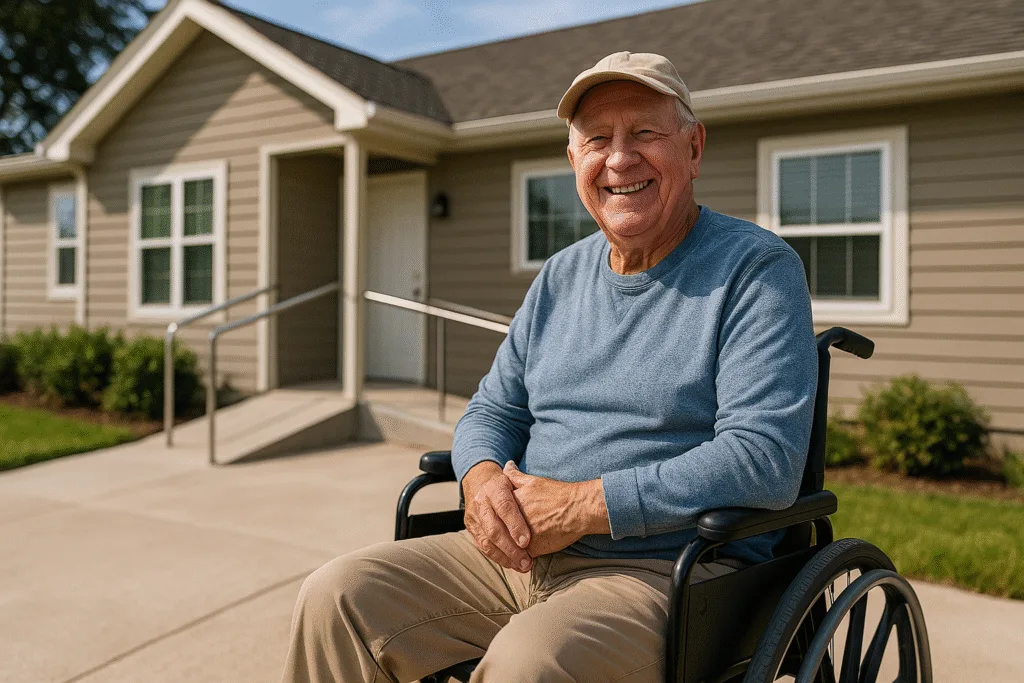
The Route to the Door: Parking, Sidewalks, and Slope
An accessible route is a continuous, unobstructed path that starts in the parking lot, not at the door. Its surface must be at least 36 inches across, firm, stable, and slip resistant. Running slope can be no steeper than 1:20 (5 percent); anything steeper is legally a ramp. Cross slope is capped at 1:48, about 2 percent, because a sideways tilt pulls a manual chair toward the curb with every push.
Accessible parking spaces must sit on the shortest accessible route to an accessible entrance. At least one in every six accessible spaces must be van accessible (a 132-inch space with a 60-inch aisle, or a 96-inch space with a 96-inch aisle). The striped aisle is the part a side-lift van user needs most.
The Doorway: Width, Hardware, Thresholds, and Floor Space
Most entry failures happen within three feet of the entry door.
Door Width: Why a 32-Inch Opening Needs a 36-Inch Door
Clear width is measured with the door open 90 degrees, from the face of the door to the opposite stop. A nominal 32-inch door yields only about 29 to 30 inches once the slab and the hinge side are subtracted, so a 36-inch door is the practical way to meet the 32-inch minimum. Older handicap doorways framed for a 32-inch slab are a frequent width failure for exactly this reason.
Hardware, Opening Force, and Closers
Lever door handles, push plates, and loop pulls pass; a round door knob and a thumb-latch pull do not, because they require grasping and twisting. Interior hinged doors may need no more than 5 pounds of force to open. Exterior doors have no federal number, so check local code. A door closer must take at least 5 seconds to swing from 90 degrees open to 12 degrees from the latch.
Automatic doors remove the force problem entirely. Sensor and push-button models both comply when they follow the ANSI/BHMA standards the ADA references and still open to a full 32 inches.
Thresholds and Small Level Changes
Thresholds are limited to 1/2 inch high in new work. A vertical edge up to 1/4 inch is allowed; between 1/4 and 1/2 inch the edge must be beveled no steeper than 1:2. Existing or altered thresholds may reach 3/4 inch if both sides are beveled. One problem we see constantly on home entries is a weatherstrip lip of barely 1/4 inch that stops a front caster dead and pitches the rider forward. A beveled threshold plate, often under $30, fixes it in an afternoon.
Maneuvering Clearance on Both Sides
A wheelchair user needs room to open a door without the chair blocking its swing. For a front approach on the pull side, the Standards call for level clear floor space 60 inches deep that extends 18 inches beyond the latch edge. A 60 by 60 inch turning space is a sensible planning figure for a landing used in both directions.
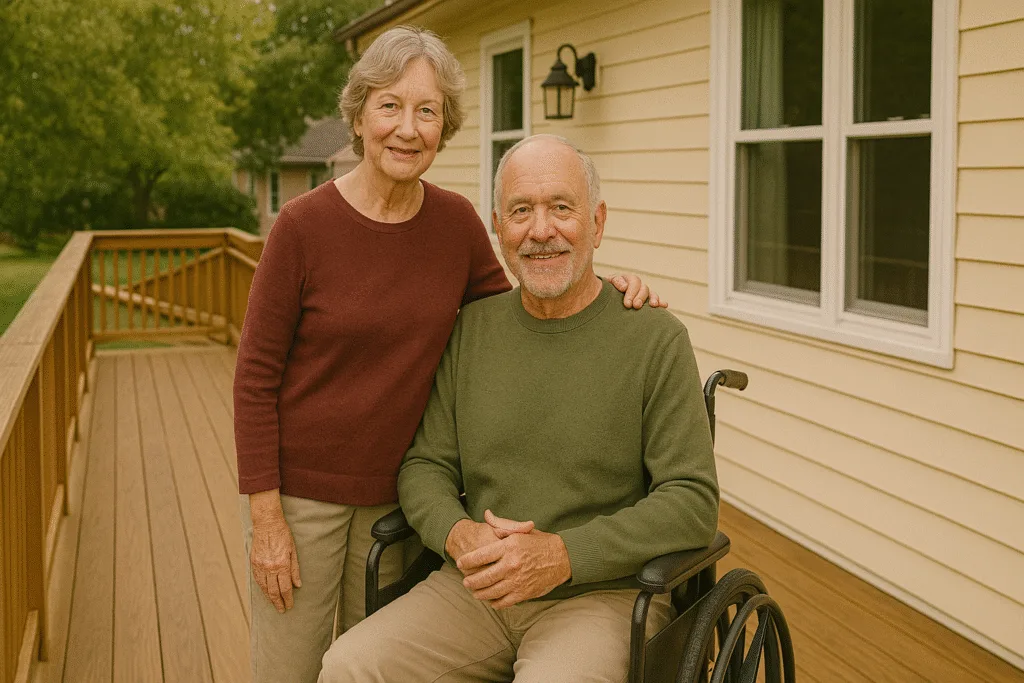
Two Doors in a Row
Vestibules trap a lot of otherwise good entries. Two hinged doors in series need at least 48 inches between them, plus the width of any door swinging into that space.
Ramps and Level Changes at the Entry
When the floor sits above grade, installing a ramp is the usual fix. The ADA maximum slope is 1:12, meaning 12 inches of run for every inch of rise: a 6-inch step needs 6 feet of run, and a 24-inch porch needs 24 feet before landings. The ramp must be at least 36 inches wide between handrails, and any rise over 6 inches needs a handrail on both sides, 34 to 38 inches high, plus edge protection so a caster cannot drop off the side. For the slope math in detail, see our guide to the maximum slope of a handicap ramp.
The reason long runs fail in practice is usually the landing, not the slope. No single run may rise more than 30 inches, which at 1:12 means a level landing at least 60 inches long every 30 feet, and another at the top where the door swings. Shortchange that top landing and the user ends up holding a heavy door while the chair rolls backward.
Modular aluminum systems bolt together in hours and suit rentals or changing needs. Poured concrete or framed wood costs more up front and lasts decades, but needs drainage planning. Our wheelchair ramp installation services page covers how each type is built. Where the interior floor already sits at one level with exterior grade, no slope is needed at all.
How Many Entrances Must Be Accessible?
In new construction, at least 60 percent of public entrances must be accessible in facilities first occupied after January 26, 1993. Existing buildings are not forced to rebuild, but four rules catch owners off guard:
- Path of travel. Altering a primary function area such as a lobby means the path of travel to it, including the entrance and the restrooms serving it, must also be made accessible, until that extra work exceeds 20 percent of the alteration’s cost.
- Barrier removal. Businesses open to the public must remove entry barriers where readily achievable, meaning doable without much difficulty or expense. A lever handle swap or a short ramp over one step at the entrance usually qualifies.
- Service entrances. A service entrance must meet the same rules when it is the only entrance to a building or tenant space.
- Elevators. Private buildings under three stories, or under 3,000 square feet per story, are generally exempt from an elevator, but shopping centers, health care provider offices, transit terminals, and government buildings are not.
Where only some entrances comply, the compliant ones must carry the International Symbol of Access, and the rest need directional signs pointing to the nearest one that works. State and local codes can add to the federal minimums, so check with your building department first.
Does the ADA Cover a Home Entrance?
No. Title III of the ADA, the part that guarantees people with disabilities access to businesses, covers public accommodations and commercial facilities, not private single-family homes. Multifamily buildings with four or more units first occupied after March 13, 1991 fall under the Fair Housing Act, which requires at least one building entrance on an accessible route unless terrain makes it impractical. For a private house, the federal numbers are still the best yardstick for a handicap accessible home.
Planning a Wheelchair Accessible Entrance at Home
Measure the door’s clear width and the threshold height, then count the steps. A single-step upgrade combines a beveled threshold plate ($15 to $30), lever handles (under $50 per door), and a modular ramp ($1,000 to $3,000), and a home entry often totals $500 to $3,000 depending on which pieces you need. Widening a 30-inch frame to take a 36-inch door costs more because it touches the wall framing.
Plan the inside at the same time. A working entry is only half the job if the bathroom fails, which is where handicap bathroom modifications come in, and our page on handicap bathroom remodeling contractors explains what that work involves. For the kitchen, review the ADA kitchen sink requirements so the rest of the house is equally usable.
Why Entries Fail After They Are Built
Compliance on opening day does not guarantee a usable entry in February. Watch for:
- Ice and wet leaves on landings; a canopy and a slip resistant surface prevent most of it.
- Blocked drains that pond water at the threshold, then freeze overnight.
- Closers drifting until the door slams in under 5 seconds or takes far more force to open.
- Planters, mats, and sandwich boards set down in the maneuvering space.
- Poor lighting that hides a cracked panel or a lifted slab edge.
A seasonal walk from the parking aisle to the inside of the door catches all of these. The same surface rules apply around water, as our guide on making a pool handicap-friendly explains.
Costs and Tax Incentives for Business Owners
About 1 in 4 U.S. adults lives with a disability, according to the CDC, and the tax code helps pay for entry fixes. The Disabled Access Credit (IRS Form 8826) gives eligible small businesses up to $5,000 a year for barrier removal, and the Architectural Barrier Removal Tax Deduction allows up to $15,000 a year.
The quickest way to judge your own wheelchair accessible entrance is to measure three things this week: the door’s open width at 90 degrees, the threshold height, and the total rise from the parking surface to the floor. If any number misses the figures above, fix the threshold and hardware first since they cost the least, then plan the slope or door widening. For help scoping that work, reach us through our contact form.
Frequently Asked Questions About Accessible Entrances
What is considered a wheelchair-accessible door?
A wheelchair-accessible door gives a clear opening of at least 32 inches with the door open 90 degrees, hardware usable with a closed fist, a threshold no higher than 1/2 inch, and level maneuvering space on both sides. A 36-inch door is the usual way to get there.
What does “accessible entrance” mean on a sign or listing?
It means the entry can be reached and used without steps, usually from accessible parking, through a door wide enough and with hardware easy enough for a wheelchair user to enter independently. Buildings with some inaccessible doors mark the accessible ones with the International Symbol of Access.
Is wheelchair access a legal requirement?
Yes, for public accommodations, commercial facilities, and state and local government buildings under the Americans with Disabilities Act of 1990. New buildings must make at least 60 percent of public entrances accessible, and existing businesses must remove entry barriers where readily achievable. Private single-family homes are not covered.