
Learning how to make a pool handicap accessible comes down to one decision: which method gives the actual user access to the water without assistance. The 2010 ADA Standards for Accessible Design recognize five options (a lift, a sloped entry, a transfer wall, a transfer system, and stairs), and they are not interchangeable. A lift or slope works for someone who stays seated; the other three ask the user to shift their own weight or climb.
Which Facilities the ADA Covers
Facilities run by local government (Title II) and public accommodations under Title III of the ADA, such as hotels, health clubs, and recreation centers, must meet these accessibility requirements by providing accessible means of entry. New and altered facilities have followed the 2010 Standards since March 15, 2012; existing ones had until January 31, 2013 to remove barriers where readily achievable, per the Department of Justice guidance. Private backyard pools at single-family homes fall outside the Americans with Disabilities Act. An HOA amenity reserved for residents usually does too, until memberships are sold to the public. If unsure, request a professional accessibility audit, similar to what’s recommended for kitchens and bathrooms under ADA rules.
The Five ADA Means of Entry Compared
| Method | Best for | Key 2010 spec | Can it be the only one? |
|---|---|---|---|
| Pool lift | Swimmers who stay seated | Seat 16 to 19 in above deck, 300 lb capacity | Yes |
| Sloped entry | Water wheelchair users, slow walkers | 1:12 max slope, 36 in wide | Yes |
| Transfer wall | Those who can slide sideways | 16 to 19 in high, 60 in long | No (spas excepted) |
| Transfer system | Those who can lift themselves step by step | Steps 8 in max rise | Wave, river, and sand bottom basins only |
| Stairs | People who walk with support | Handrails 20 to 24 in apart | No |
Large pools, with 300 or more linear feet of pool wall, need two options, and the primary one must be a lift or a graded entry. One with less than 300 linear feet of wall needs just one, also one of those two. That catches many hotel owners: handsome stairs with railings never satisfy the rule on their own, according to the ADA.
How to Make a Pool Handicap Accessible, Starting With the User
Start with what the person can physically do; buying hardware first is how families end up with a transfer wall nobody uses.
- Can’t bear weight or transfer: a pool lift.
- Can slide across from a wheelchair seat: a transfer wall or system, with no motor to fail.
- Walks with a cane or walker: a ramp or stairs with dual rails to wade in.
- Mixed users (children, older adults, therapeutic classes): a beach entry serves the most people with mobility issues.
Then plan in this order:
- Measure the wall in linear feet; it sets whether one or two options are required.
- Check depth: a pool lift must sit where the water is 48 inches deep or less, unless the whole basin is deeper.
- Confirm deck space: 36 by 48 inches beside a lift seat, 60 by 60 inches at a transfer wall or system, no steeper than 1:48.
- Install the primary option, then a secondary one if required.
- Keep pool equipment charged, in place, and working whenever the facility is open.
Swimming Pool Lift Specs That Decide ADA Compliance
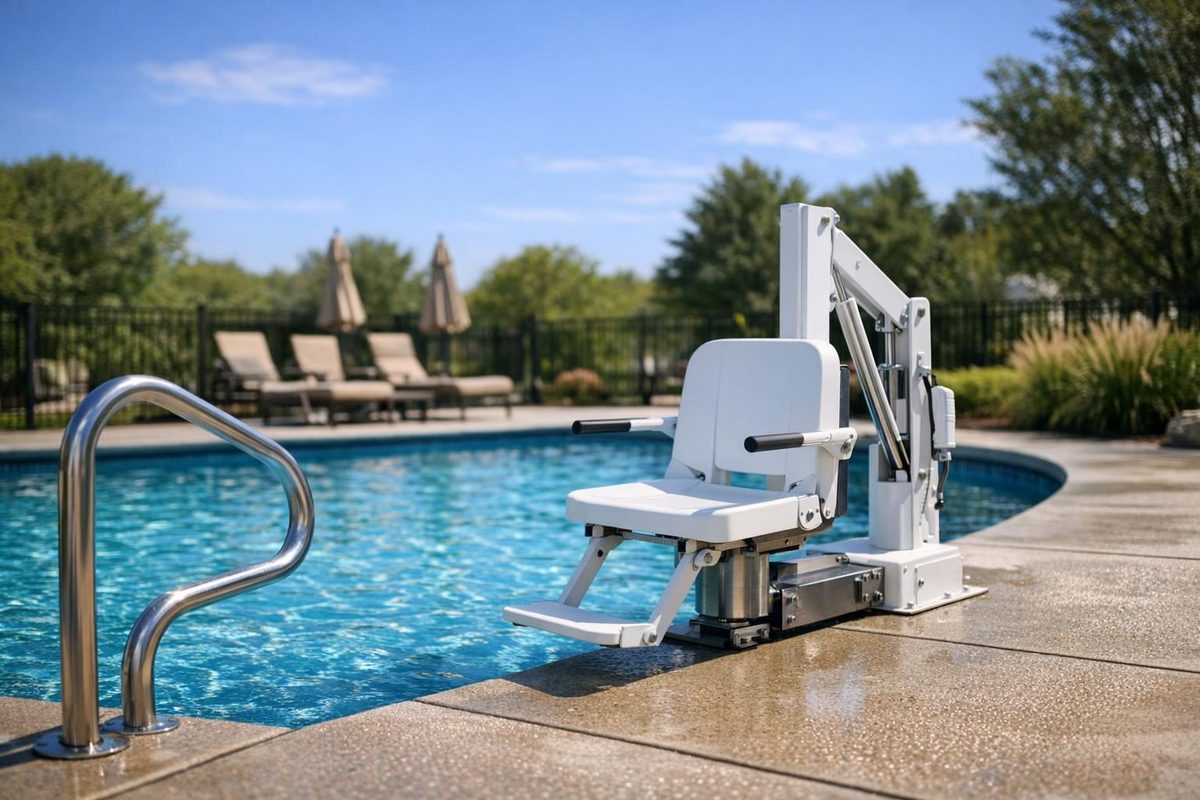
A swimming pool lift is a battery-powered or hydraulic seat that lowers a seated person into the water and raises them back out. Under section 1009.2, the ADA requires a seat at least 16 inches wide that stops 16 to 19 inches above the deck, a 300 pound minimum capacity, at least 18 inches of submersion, footrests, and controls the user can run from the deck and the water.
Portable lifts suit existing setups where a fixed unit isn’t readily achievable, but they must stay at poolside during open hours, not in storage. Before ordering a fixed model, check that the deck concrete is sound enough for anchor sockets. Equipment costs run $3,000 to $7,000. Labor adds $500 to $1,500. Get multiple quotes because prices vary significantly by region and model.
Building a Swimming Pool Ramp for Disabled Swimmers
A sloped entry, also called a beach entry or zero entry, is a submerged ramp that lets a person walk or roll down a gradual grade. Its maximum ramp slope is 1:12, it must be 36 inches wide, end 24 to 30 inches below the water, and carry rails on both sides 33 to 38 inches apart.
The geometry surprises owners. Dropping 30 inches at 1:12 takes 30 feet of run, the same math behind wheelchair ramp installation at a front door. A personal chair can’t go in the water, so users switch to a PVC or stainless aquatic chair. The built-in grade mirrors curbless showers and other bathroom modifications. A retrofit may involve significant excavation, so check local building codes first; it ranges from $5,000 to $15,000 depending on layout and soil, and costs far less when built into a new pool.
Transfer Walls, Transfer Systems, and Stairs
A transfer wall is a raised ledge 16 to 19 inches high, 12 to 16 inches wide, and 60 inches long, with a grab bar across it, where a person slides off a chair to enter the pool. The ADA accepts it as a secondary means on large pools, never as the only one. A transfer system adds submerged steps no taller than 8 inches below a platform. Both suit people with disabilities who have upper-body strength, usually cost $1,500 to $3,000 to retrofit, and need non-slip surfacing, a detail often overlooked.
Pool stairs need a handrail on each side, 20 to 24 inches apart, with extensions at the top landing only. Contrasting nosing strips help people with low vision, though they aren’t an ADA rule. A ladder never counts, but one at the far end gives able-bodied users easy access. Understanding what qualifies as a wheelchair accessible entrance helps with stair placement: clear path, adequate width, no abrupt level changes.
Private Backyard and Above Ground Pools
No federal standard governs a family’s own pool, but the 2010 dimensions remain a sound checklist.
In-Ground Pools at Home
A deck-mounted or portable lift is the quickest fix for an existing pool, while a zero entry makes sense when the design is still on paper. Add slip-resistant decking and a 60-inch turning circle beside the access point, since a person with a physical disability often waits longer at the edge. Many families pair this with accessible bathroom remodeling for aging in place.
Above Ground Options
An A-frame ladder over a 48-inch wall is unusable for most people with limited mobility. Two layouts work better: a deck built to the top of the wall with a lift rated for above ground use, or a wide step system with rails on both sides.
The fastest way to settle how to make a pool handicap accessible is to measure the wall, watch the person transfer from their chair, and price a lift and a ramp side by side before anything is excavated. If the facility serves the public, lock in one of those two as the primary option. Then request a free consultation to plan the layout.
Common Questions About Wheelchair Water Access
How do you get someone in a wheelchair into a pool?
Most facilities use a pool lift: the person transfers to the lift seat, which lowers at least 18 inches below the water. A graded walk-in works with a water wheelchair, and a transfer wall suits anyone who can slide across.
What makes a pool ADA compliant?
An accessible pool has the required number of accessible means built to the 2010 Standards: one below 300 linear feet of wall, two above, with a lift or slope as the primary. Each must be maintained and working whenever the facility is open.
How much does it cost to add accessible features?
A lift runs $3,000 to $7,000 plus $500 to $1,500 for labor. Transfer walls cost $1,500 to $3,000. A full zero entry retrofit ranges from $5,000 to $15,000.
Can someone with limited mobility use a spa?
Yes. A public spa needs a lift, transfer wall, or transfer system, and where spas are clustered, 5 percent (at least one per cluster) must be accessible.